- Full Event(video)
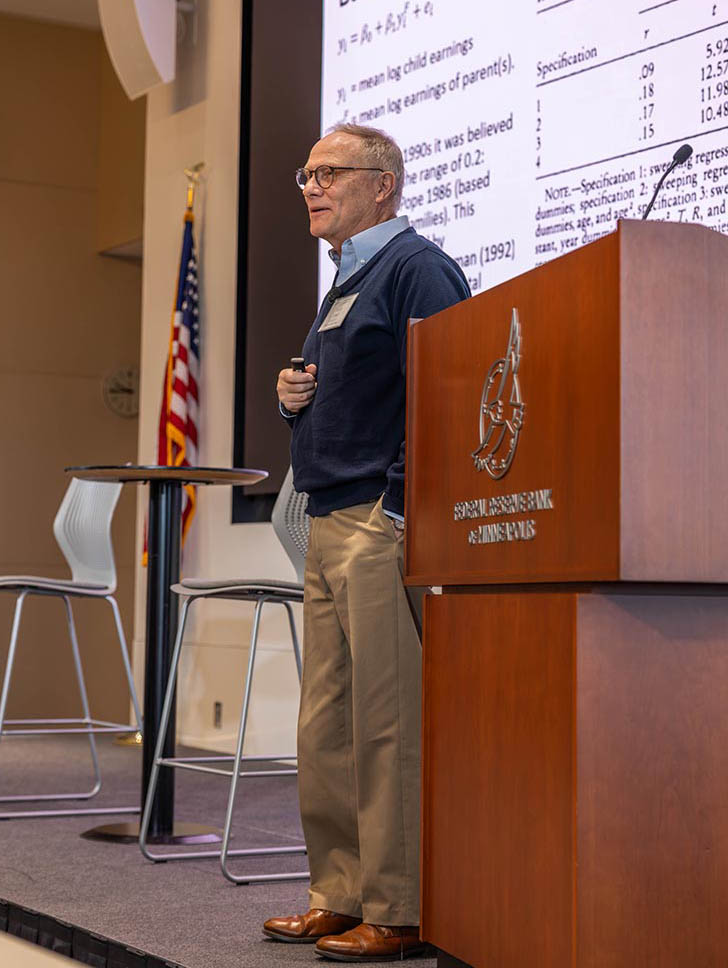
The Opportunity & Inclusive Growth Institute’s annual research conference showcases the range of frontier-style research that the Institute engages with and supports. Presenters, discussants, and attendees will engage in a broad scholarly exchange of ideas around presented papers.
This year’s event will feature a keynote conversation between Congressional Budget Office Director Phillip Swagel and Minneapolis Fed President Neel Kashkari. Swagel previously served as Assistant Secretary of the Treasury for Economic Policy and in roles at the Federal Reserve Board of Governors, the International Monetary Fund, and the White House Council of Economic Advisers.
The second day of the conference is an Early Career Researchers’ Workshop, which focuses on developing research of scholars who have completed their Ph.D. in the last eight years (from 2018 to 2025).
The conference organizer is Amanda Michaud, and this year’s program committee members are Francesco Agostinelli, Alex Albright, Marcus Casey, Amanda Michaud, Makoto Nakajima, Emi Nakamura, and Fang Yang.
Event Details
Minneapolis, Minnesota
Register for livestream
This registration is for the livestream only. For inquiries about in-person registration, please email MplsInstitute@mpls.frb.org.
Online viewers can ask questions by visiting pigeonhole.at and entering the code 2026INSTITUTE.
Event Agenda
Thursday, October 8 |
|
|---|---|
| 9:30–9:40 a.m. CT |
WelcomeAbigail Wozniak, Federal Reserve Bank of Minneapolis |
| 9:40–10:20 a.m. CT |
Keynote remarks and fireside chatCongressional Budget Office Director Phillip Swagel in conversation with Minneapolis Fed President Neel Kashkari |
| 10:30–10:35 a.m. CT |
Research program remarksAmanda Michaud, Federal Reserve Bank of Minneapolis |
| 10:35–11:25 a.m. CT |
The Long-Term Decline of the U.S. Job Ladder [Paper]Niklas Engbom, New York University; Aniket Baksy, University of Melbourne; and Daniele Caratelli Presenter: Niklas Engbom, New York University |
| 11:35 a.m.–12:30 p.m. CT |
A Family Affair: The Effects of College on Parent and Student Finances [Paper]Palaash Bhargava, Max Planck Institute for Behavioral Economics; Sandra E. Black, University of Texas at Austin; Jeffrey T. Denning, University of Texas at Austin; Robert W. Fairlie, University of California, Los Angeles; and Oded Gurantz, University of Colorado, Boulder Presenter: Sandra Black, University of Texas at Austin |
| 1:45–2:40 p.m. CT |
Automation, Learning, and Career Dynamics [Paper]Hassan Afrouzi, Columbia University; Andres Blanco, Federal Reserve Bank of Atlanta; Andres Drenik, University of Texas at Austin; and Erik Hurst, University of Chicago Presenter: Andres Drenik, University of Texas at Austin |
| 2:55–3:50 p.m. CT |
Supply Constraints Do Not Explain House Price and Quantity Growth Across U.S. Cities [Paper]Schuyler Louie, University of California, Irvine; John Mondragon, Federal Reserve Bank of San Francisco; and Johannes Wieland, University of California, San Diego Presenter: John Mondragon, Federal Reserve Bank of San Francisco |
| 4:00–4:55 p.m. CT |
The Macroeconomics of Intergenerational Mental Health Dynamics [Paper]Boaz Abramson, Columbia University; Job Boerma, University of Wisconsin–Madison; Diego Daruich, University of Southern California; and Aleh Tsyvinski, Yale University Presenter: Diego Daruich, University of Southern California |
| 4:55–5:00 p.m. CT |
Closing remarks |
PAPER SUMMARIES
A Family Affair: The Effects of College on Parent and Student Finances
Palaash Bhargava, Sandra E. Black, Jeffrey T. Denning, Robert W. Fairlie, and Oded Gurantz
Many parents rely on student loans to help fund their children’s collegiate education. The authors use administrative data on Californian federal student aid applicants to study how much debt and what types of debt parents use when their child attends college. Higher-income parents shift their borrowing from credit card and auto debt to educational debt but do not increase total borrowing. For lower-income parents, borrowing goes up as they take on student loans. And yet, their educational borrowing is associated with less delinquency on noneducational loans, increased credit scores, and lower likelihood of filing for bankruptcy. The authors find that parents change their consumption and savings behavior as the price they face changes, which carries implications for the overall health of the macroeconomy.
Automation, Learning, and Career Dynamics
Hassan Afrouzi, Andres Blanco, Andres Drenik, and Erik Hurst
In many white-collar occupations, workers learn by doing entry-level tasks through which they acquire the skills necessary to grow their careers. Technologies like generative artificial intelligence have the potential to affect on-the-job skill accumulation through two opposing effects: the automation of entry-level tasks through which workers acquire skills and the augmentation of the tasks of managerial employees who have already gained entry-level skills. The authors show that if the price of automation is too low, cheap technology does not deliver broad productivity gains because entry-level work is fully automated and the learning pipeline shuts down.
The Long-Term Decline of the U.S. Job Ladder
Niklas Engbom, Aniket Baksy, and Daniele Caratelli
Real wage growth has been low in the United States since the 1980s, despite significant productivity growth. The authors examine how rising employer concentration and the growing prevalence of noncompete agreements have curtailed job-shopping by employed workers, with the result that employed workers today are half as likely to receive a better-paying outside offer as they were in the 1980s. Due to less competition for workers, firms do not offer higher wages and employees face slowed upward mobility. The authors conclude that this accounts for about one-third of the post-1980 slowdown in real wage growth.
Supply Constraints Do Not Explain House Price and Quantity Growth Across U.S. Cities
Schuyler Louie, John Mondragon, and Johannes Wieland
The debate on housing affordability often argues that constraints on the supply of housing are the main cause of rising house prices. The authors of this paper provide evidence that differences in supply elasticity across cities do not explain nationwide variations in housing price growth. So what does explain the variation? The authors show that demand for housing quality, not quantity, is key. They illustrate this mechanism by comparing housing price trajectories in San Francisco and Houston. In San Francisco, per capita income growth drove up demand for better-quality housing, increasing house prices. In Houston, population growth caused demand for housing units to increase, supply responded, and house prices increased less than in San Francisco.
The Macroeconomics of Intergenerational Mental Health Dynamics
Boaz Abramson, Job Boerma, Diego Daruich, and Aleh Tsyvinski
The authors develop a novel macroeconomic theory of children’s mental health and life cycle development. At the crux of the model is intergenerational transmission. When parents experience mental illness, they tend to invest less time and monetary resources in their children. This in turn reduces a child’s cognitive and behavioral development. The authors use the model to estimate the relationship between population trends in mental health and macroeconomic outcomes, specifically productivity, earnings, and consumption. Using this model, they then evaluate child mental health policies, finding that joint subsidization of mental health care for children and parents produces the largest gains for employment, wages, and productivity.
EARLY CAREER RESEARCHERS’ WORKSHOP
The Early Career Researchers’ Workshop will be held Friday, October 9, in person at the Federal Reserve Bank of Minneapolis. This event is an opportunity to provide constructive feedback and networking opportunities to scholars up to eight years post-Ph.D. Attendance will be by invitation only, and the event will not be recorded or posted later. We encourage you to visit participants’ webpages to engage with their scholarship.
Workshop Agenda
Friday, October 9 |
|
|---|---|
| 9:00–9:05 a.m. CT |
Welcome |
| 9:05–9:40 a.m. CT |
When Did Boys Fall Behind? A Historical Analysis of Gender Gaps in EducationAnne Hannusch, University of Bonn Presenter: Anne Hannusch, University of Bonn |
| 9:40–10:15 a.m. CT |
Income Inequality and Economic ExclusionRobert Manduca, University of Michigan Presenter: Robert Manduca, University of Michigan |
| 10:30–11:05 a.m. CT |
A Theory of Firm Wage DynamicsMarc de la Barrera, IESE Business School; Masao Fukui, Boston University Presenter: Masao Fukui, Boston University |
| 11:05–11:40 a.m. CT |
Firm Dynamics and the Cyclicality of Labor Market SortingCarter Bryson, U.S. Bureau of Economic Analysis Presenter: Carter Bryson, U.S. Bureau of Economic Analysis |
| 11:40 a.m.–12:15 p.m. CT |
Outside Options, Monopsony, and Product Market PowerHamid Firooz, North Carolina State University; Agustín Gutiérrez, University of Wisconsin–Madison; Attila Gyetvai, University of Florida Presenter: Hamid Firooz, North Carolina State University |
| 1:00–1:35 p.m. CT |
Marketization and Marriage in a Task-Based Model of Home ProductionMatthew Schwartzman, University of Michigan; Lindsey Uniat, Federal Reserve Bank of San Francisco Presenter: Matthew Schwartzman, University of Michigan |
| 1:35–2:15 p.m. CT |
Masculinity Norms, Occupational Choice, and Reallocation: Micro and Macro EvidenceRachel Schuh, Federal Reserve Bank of New York; Martina Uccioli, University of Nottingham Presenter: Rachel Schuh, Federal Reserve Bank of New York |
| 2:30–3:05 p.m. CT |
Housing and the Heterogeneous Welfare Cost of InflationJames MacGee, Western University; Yuxi Yao, University of Nebraska–Lincoln Presenter: Yuxi Yao, University of Nebraska–Lincoln |
| 3:05–3:45 p.m. CT |
Small group discussions |