Author

Ella Tracy
Intern, Institute
Sometimes, the best way to understand an idea is to meet the people who devote their time and energy to studying it. This series of short Q&As spotlights individuals whose research seeks to understand how economic opportunity and inclusive growth work in America today.
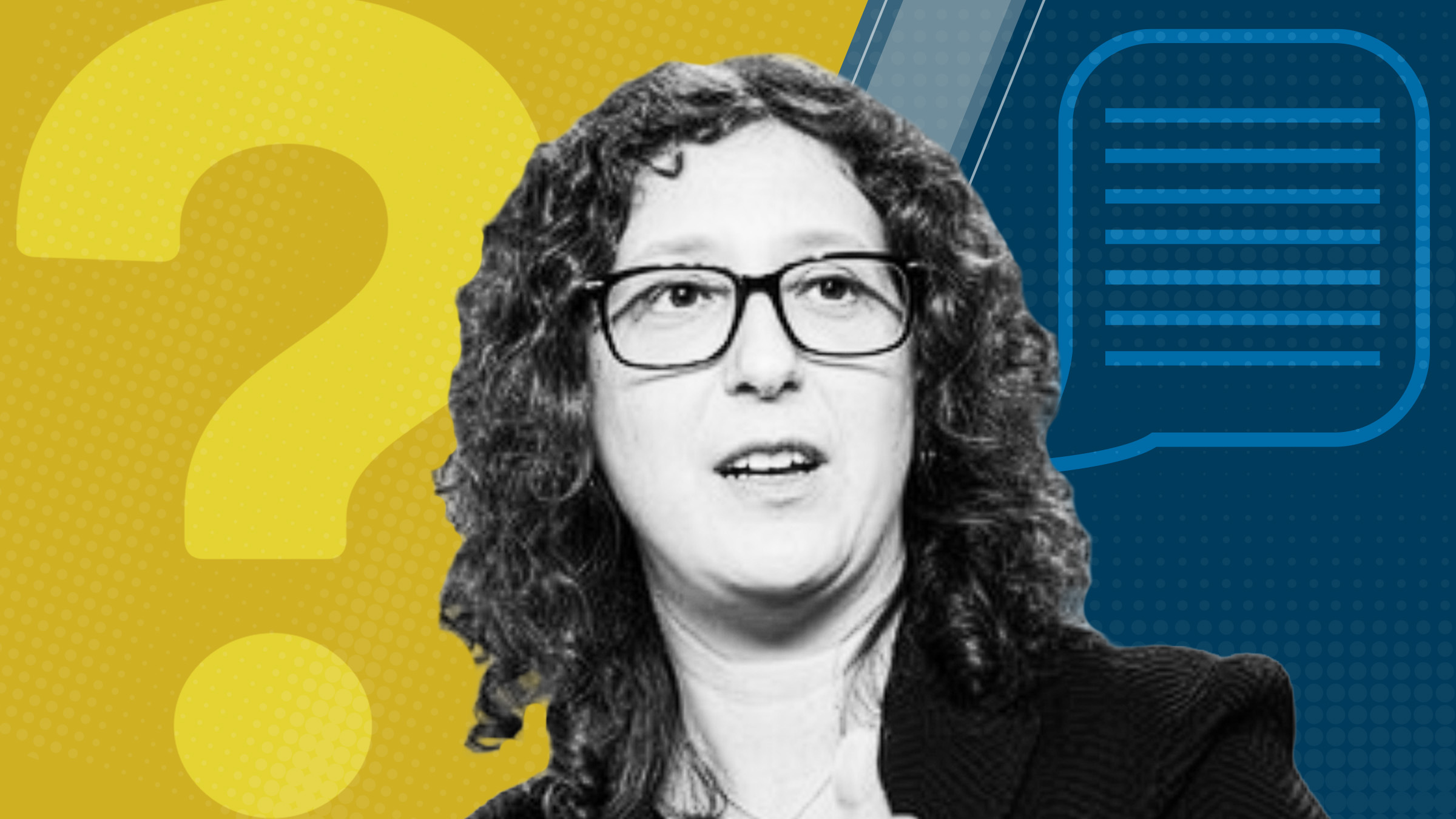
For this installment, we sat down with Institute visiting scholar Pamela Giustinelli, professor of economics at the University of Padova, to discuss uncertainty, cooking, and her research on decision-making.
What made you decide to study economics?
I actually did not study economics before going to college. I’m Italian, and in Italy, we choose a high school track quite early on. I went to a high school that was heavy on math, science, and analytical subjects, but also included things like literature, philosophy, and so on. I had this combination of training that is quantitative in nature but also interested in human behavior.
My guess is that eventually economics became attractive because it allowed me to bring together these two things. It gave me these formal quantitative tools that I like and I was trained in. And the research questions could be about people, like how people form judgments, how they make choices, and how these choices shape their lives. Those are the questions that I study in my research.
What do you think is one of the most useful ideas in economics?
This is a tough question because I think there are many useful ideas that economics gives us. But I will mention one that I use a lot in my research, which is the idea that people make decisions under constraints and under uncertainty. You can think of uncertainty as a type of constraint, an informational constraint. People also make decisions based on what they believe the consequences of their actions will be, which means that they need to form beliefs both about the consequences of the action that they will actually take and about the consequences of alternative actions that are potentially feasible but not chosen.
Sometimes people’s beliefs are accurate; sometimes they’re not. We know that beliefs are very heterogeneous across people. And I think what’s important and powerful and fascinating about this idea is that if we want to understand how people make important decisions, such as those related to schooling, health, work, or retirement, we need to understand not only the incentives that decision-makers face but also how they perceive those incentives.
What are you studying now?
I’m working on a lot of things, but most of them essentially study how people form judgments. By judgment, I mean beliefs, expectations, forecasts, and perceptions, and how these judgments affect their economic behavior.
Lately, I’ve been interested in beliefs about complex subjects like expected returns on educational investments or the perceived effect of a policy or a belief about the way that health is produced. For example, in one project right now with a colleague of mine, we are studying how chief financial officers of large U.S. firms make forecasts about multiple variables simultaneously and whether these forecasts are internally consistent with one another, and not just whether they’re accurate or not relative to what actually happened.
In another project with a number of co-authors, we are studying how UK adults form beliefs about their health, and more specifically, about how typical health investments, such as diet and exercising behavior, affect their future health.
In another project with Italy-based co-authors, we are studying how Italian junior high teachers form recommendations to students on which high school track to choose.
You might think, Oh, these are very different projects unrelated to one another. From my point of view, they are connected by a common theme. In fact, I would say even by the very same question, which is, How do people think about uncertain consequences of their actions, and how do these beliefs shape the decisions that they make?
How does your research relate to economic opportunity and inclusive growth?
First, I would say that many decisions that I study are consequential decisions—decisions related to education, health, work and retirement, firm investment. I think it’s clear that these choices have long-lasting consequences for the individuals that make them and for society, in particular how resources are allocated in the economy.
The other way in which I think my research is related to opportunity and inclusive growth is that I have this focus on subjective beliefs and expectations. These beliefs and expectations are very different across people. You could have two almost identical people facing the same choice, but these people may have different expectations or information, or receive different advice from their teachers, in the case of students choosing a major. Because of that, they may perceive their opportunity set very differently.
So to summarize, I think that inclusive growth is not just about expanding people’s actual opportunity sets. It’s also about understanding how people think about those opportunities, whether they understand them, and whether they receive the information and the support that they need to act.
A lot of economics historically is based on assuming that people have perfect information and correct beliefs, which makes objective and subjective beliefs the same thing. But we know that that’s not the case. For decision-making, what really matters is what people believe and expect.
What is an important economic statistic that you think people should know?
To be honest, I rarely get interested in a statistic per se. What often interests me about a statistic is the conceptual and methodological aspect behind it. When I see any given statistic, I start wondering, Oh, what are we really trying to measure here? What are the assumptions that we need to interpret it? So for me, it’s more what’s behind the construction of the statistic.
What is a helpful piece of advice that you have received?
When I was working on my Ph.D. thesis, my Ph.D. supervisor, Chuck Manski, told me to stop running analyses and start writing. And I still remember that very vividly. I think what he meant was to stop adding regressions, stop extending your model, stop trying robustness checks and force yourself to sit down and write down what you have learned so far.
I found that very useful, because when I sit down and try to explain an idea or something that I found in an analysis clearly in writing, I realize that sometimes I don’t yet understand it fully. Or in the process of doing that, I realize something that I hadn’t realized before. The structure of writing sometimes even generates new ideas and questions. And so I’ve come to believe that writing is essentially thinking, which is not a novel idea, but this is my personal experience and I think it was a good piece of advice.
If you could talk to anyone in the world for an hour, who would it be and what would you want to talk about?
One on my mind right now is Fei-Fei Li. She’s a professor of computer science at Stanford University. She wrote a very interesting book recently titled The Worlds I See. I would love to chat with her about AI, education, and human judgment. Of course, you know by now that I’m very interested in how people form beliefs, make decisions, and so on. I think AI involves fascinating questions about what machines can help us do, but also what remains distinctively human, such as curiosity or interpretation or empathy, or maybe even responsibility at the end of making a decision.
If you had a news station, what would you want to report on?
I would probably try to report about uncertainty. It might sound funny because if you think about a typical news station, news is often presented as if the goal were to tell people exactly what happened and what they should think about. But I often feel that the problem is that we are missing the gray area. How much do we really know? How confident should we be? What would change our mind? What are alternative interpretations? I think real life is not binary. It’s not black and white. It’s very complex. It’s full of uncertainty, ambiguity, competing mechanisms, and imperfect information.
The goal would not be to make people scared or paralyzed or cynical, but to make them more comfortable thinking probabilistically. I think that is an important skill in its own right and especially in our current complex world.
If you could have any job for one day, what would it be?
I think I would go for a chef in a very good restaurant. Partly because I like cooking and I’m a foodie, but also because I view cooking as something that is both creative as well as practical and disciplined at the same time. The timing matters, the materials matter, the teamwork matters, the feedback is immediate. This is very different from research, where we have this long-time horizon and the feedback can take quite a long time to arrive.
This interview was edited for length and clarity.