Authors


Sarah Miller
Ross School of Business at the University of Michigan

The intestinal worm Necator americanus (commonly known as hookworm) arrived in the warm, humid climate of the South with the slave trade and remained endemic there until the 1950s. Hookworm spread through people’s bare feet around unsanitary privies, and in the early 20th century 40 percent of children in 12 states from North Carolina to Texas were infected. Worms consumed their victims’ blood, causing listlessness, lack of focus, and stunting, especially in children, who often missed school or couldn’t pay attention.
Hookworm took an enormous toll on health—so much so that it held back the Southern economy. The parasites “so lower the vitality of those who are affected as to retard their physical and mental development … [and] make labor less efficient,” wrote a group of physicians and civic leaders in 1909, and the disease was “seriously affecting economic development.” Stock prices of cotton mills in highly infected areas ran noticeably lower than in areas with lighter infection because “it takes, by actual count, about 25% more laborers to secure the same results in the counties where the infection is heavy.”
The story of hookworm illustrates a fundamental, but often overlooked, input into economic growth: health. Classical economic models view output in terms of machines and materials, work hours, workers’ skills, and the technologies that combine them. When people are unhealthy, the middle of this equation falls out. Sluggish students cannot learn. Sick workers cannot produce. Economic growth benefits from population health.
Health remains a key issue in discussions about the U.S. economy today. In fact, 8.6 percent of U.S. gross domestic product goes toward public programs that are meant to support health. Most of this spending is for the public health insurance programs Medicare and Medicaid. But does this spending actually maintain health, and if so, does that deliver economic benefits? In this article we review evidence on the link between one specific type of health spending, Medicaid’s coverage of children, and how those children influence the economy when they grow up.
Medicaid’s coverage of children
Today Medicaid provides health insurance to over 35 million children 18 and under and about 1.5 million pregnant women, representing about 47 percent of American kids and 41 percent of births. Children typically qualify for Medicaid based on income, and once they are on the program, they usually pay nothing for medical care. Health care providers who treat them are reimbursed by the state Medicaid agency or a private insurance plan funded by Medicaid. No other income-tested program reaches as many children and, to the extent that Medicaid affects their health, no other program has such scope to shape their economic trajectories.
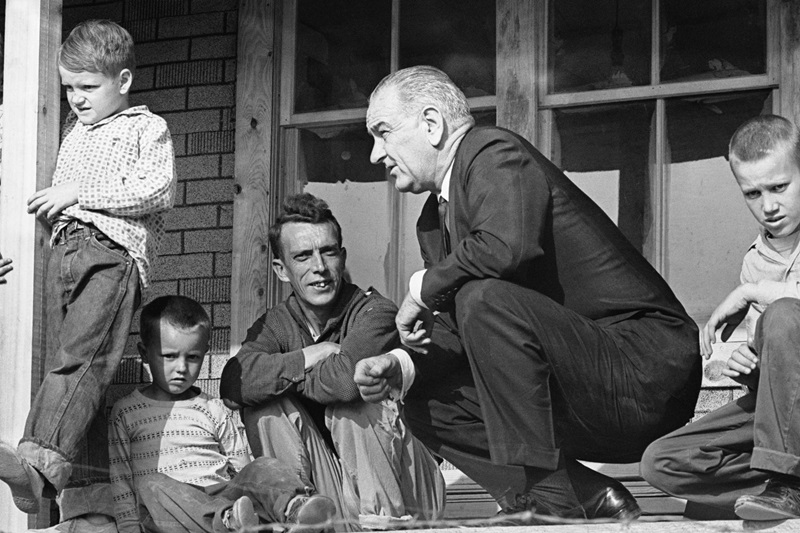
When Medicaid was born in 1965, the link between health and productivity was fresh in policymakers’ minds. A 1964 Department of Defense report found that a full one-third of 18-year-old men would fail to meet peacetime standards for military service, with about half of these disqualifications related to preventable health issues. About one-third of children—but almost all poor children—lacked health insurance, and less than half of the children with incomes in the bottom 10 percent even visited a doctor each year (Goodman-Bacon 2021).
In response to these concerns about health outcomes for America’s youth, President Lyndon B. Johnson proposed a public insurance program: Medicaid. On Medicaid, low-income Americans could receive medical care from existing providers, who would then be paid with public funds. The federal government pays most of Medicaid’s costs, but states mostly run it. Programs began operating in 1966, and by 1975, they covered 10 million children, a dramatic increase from the mid-1960s (Figure 1). At the same time, the number of children with no insurance fell by almost the same amount, and the poorest children in the country began to see doctors at the same rates as everyone else, with approximately 70 percent visiting a doctor in a year (Goodman-Bacon 2021).
Originally, Medicaid served children whose families received cash welfare, but over time, federal mandates have made Medicaid eligibility more generous. In the 1980s, policymakers sought to expand coverage by moving children’s Medicaid eligibility to a simpler standard: family income itself. Over the next decade and a half, the number of children enrolled in Medicaid increased from about 9.3 million in 1980 to 17.1 million in 1995 (Figure 1). Today, states must cover all children in households with income less than 133 percent of the federal poverty line (which comes to about $44,000 for a family of four), but all states go beyond that, extending coverage to children in families earning as much as 400 percent of the poverty line.
In 2023, Medicaid spent about $4,000 per child, not much different from the average cost of care for children not on Medicaid. This spending is skewed toward children with the kind of health needs that can shape health and productivity years later. For example, half of preterm births in the U.S. are covered by Medicaid (Meltzer and Markus 2020), and the acute care that helps these infants regulate their body temperature, absorb oxygen, and finish their physical development has been shown to raise academic achievement in elementary, middle, and high school (Bharadwaj et al. 2013).
But high spending on critical needs is not the only way that Medicaid might have longer-run effects. The program also funds a large amount of low-cost prevention. In fact, at least 80 percent of children on Medicaid use very little costly care, but nevertheless receive important screenings, checkups, and preventive services (Kuo and Houtrow 2016).
A large research base tries to understand how and how much Medicaid coverage affects children’s health in the short run. This evidence consistently shows that Medicaid boosts health care use and improves health, especially for the lowest-income children. By the end of the 1970s, for instance, Medicaid had saved about 35,000 children’s lives by supporting better delivery care for infants and protecting younger children against infectious diseases (Goodman-Bacon 2018). As it expanded to other low-income families in the 1980s, Medicaid generated similarly large health improvements (Currie and Gruber 1996a, 1996b). Expansions to higher-income children, however, did not have such profound effects (Currie et al. 2008), perhaps because many of these families already had access to insurance (Lo Sasso and Buchmueller 2004).
A longer-term view raises further questions about childhood Medicaid coverage—the same kinds of questions that arose alongside hookworm infections decades earlier. Do Medicaid’s short-run health effects last into adulthood? Do they open up the pathways through which children gain skills and grow into healthy, productive workers? Does Medicaid ultimately feed back into the economy?
Medicaid’s lasting effects on the labor force
The millions of children originally covered by Medicaid provide the first good opportunity to learn whether and how the program shapes economic outcomes down the line. Medicaid’s original connection to cash welfare programs meant there was meaningful variation across states in the share of children who received any coverage and the number of years they were covered.
For example, about 1 percent of White children in Virginia gained access to Medicaid when it began, compared with 3 percent in Tennessee. And these differences added up across childhood. The average child born around the mid-1960s in the top half of states ranked by this welfare-based Medicaid eligibility measure accumulated about 1.5 years of Medicaid eligibility before age 11; kids from the bottom half of states gained one year. Practically, this meant that kids in higher-welfare states grew up with more opportunities than similar kids from lower-welfare states to see doctors, get prescriptions, receive screenings, and undergo surgical procedures as a result of Medicaid. If this spending prevented or treated illnesses, made it easier to attend and focus on school, and ultimately made for healthier adults, we should see better economic outcomes for people who grew up in states with higher Medicaid eligibility.
This is exactly what census data from the 2000s show. Figure 2 plots differences in adult employment rates (in yellow) between kids born in higher- versus lower-welfare states by birth cohort. There is little difference in employment rates in the two groups of states for adults born long before Medicaid was available (the yellow line is close to zero). But among people who were in elementary school or younger when Medicaid began, adult employment rates are higher by about one-half of a percentage point for those who grew up in higher-Medicaid areas. Adjusting for differences in cumulative childhood eligibility across states suggests that raising average childhood Medicaid eligibility by one year raises employment by about 4 percentage points (Goodman-Bacon 2021). This is a substantial effect when compared with the national employment-to-population ratio, which rose by about 10 percentage points from its trough in the 1950s to its peak in 2000.
Measuring earnings instead of just employment, which incorporates both who enters the workforce because of Medicaid and any effects on education or productivity of workers, shows that groups with one additional year of average childhood eligibility experienced a 2.7 percent increase in earnings, concentrated among lower-income workers most likely to have used the program. To put this in context, each year of early life Medicaid exposure raises earnings by almost as much as a year of adult labor market experience.
These labor market effects appear to stem from just the kind of health improvements that Medicaid’s architects had in mind. Figure 2 also shows that adult disability rates are systematically lower for the cohorts and states where Medicaid raised employment. Unlike in cases of specific pathogens, such as hookworm, Medicaid provided broad-based care against childhood ailments. Occupational therapy to manage physical limitations, prevention or early treatment of acute infectious diseases that have longer-term consequences, and early diagnosis of chronic and potentially deadly or disabling conditions could all underlie the program’s long-run health effects. Other research confirms this finding. Early Medicaid coverage in the 1960s and 1970s is associated with lower adult mortality, disability, and chronic disease burden (Boudreaux et al. 2016; Sohn 2017; Goodman-Bacon 2021), explaining why an investment in children’s health ultimately paid off in the labor market.1
A second chance to learn about Medicaid’s effects on labor market outcomes came in the 1980s, when eligibility was expanded beyond its original link with cash welfare. Some states already covered most poor children, so new federal mandates that set income-based eligibility rules resulted in very little new Medicaid coverage. In other states, however, thousands of children gained coverage for the first time.
A series of different research teams took advantage of this variation across states to study the long-term impacts of these 1980s-era expansions, and all pointed toward the same conclusions as the 1960s-era research. Medicaid led children to perform better in school, repeat grades less often, graduate high school at higher rates, and attend and finish college more (Thompson 2017; Cohodes et al. 2016). Newly covered children were diagnosed with and hospitalized for fewer chronic conditions than other children, and their mortality rates as teenagers and young adults were lower (Thompson 2017; Wherry et al. 2018; Miller and Wherry 2018; Brown et al. 2020). The effects continue to echo: Girls who gained Medicaid coverage as children in the 1980s went on to give birth to healthier babies in the 2000s (East et al. 2023).
As in the 1960s, improvements in health and education went hand-in-hand with better labor market outcomes. For example, one study compared kids whose birthday happened to fall on either side of a strict eligibility cutoff in a 1991 Medicaid reform. It found that Medicaid eligibility reduced later-life incarceration (Arenberg et al. 2024), a finding echoed in more recent work looking at children who lose access to mental health therapy and medications when they become too old to get Medicaid (Jácome 2024). More broadly, the largest study, based on tax data, found that each year of Medicaid eligibility in childhood raised annual earnings by about 0.8 percent (Brown et al. 2020).
Medicaid in childhood and long-run effects on the economy
Together, this evidence on Medicaid’s long-run effects is broadly consistent across studies, research teams, datasets, and policy regimes. But are these benefits large enough to affect the economy? Traditional economic models provide one way to connect the findings about childhood Medicaid and adult earnings to conclusions about aggregate economic output (Weil 2007). If earnings reflect the value of what workers produce, then the earnings gains from Medicaid are also its contribution to national output.
To measure this, we first calculate the effect of Medicaid on adult earnings for each birth cohort based on their amount of childhood exposure. People born in 1965, for example, accumulated almost one year of eligibility during the earliest era of Medicaid policy, raising their earnings by almost 2.7 percent. Cohorts born in the 1980s accumulated about four years of Medicaid exposure because they were children during the period when eligibility expanded. Combining this with the findings on Medicaid’s labor market effects suggests that their childhood eligibility raised these cohorts’ average earnings by as much as 6 percent.
Next we calculate the share of total earnings in a given year that come from each cohort, a measure of their contribution to aggregate output. The 1965 cohort, for example, is relatively large. In 2005 at age 40, they were near the peak of their earnings profile, meaning their contribution to aggregate output was large. By 2024, however, the 1965 cohort was smaller in number and had lower mean earnings because some left the labor force. Their 6 percent earnings gain because of Medicaid thus translates to less of an effect on the overall economy. Similarly, the contribution of the 1980s cohorts to aggregate output started out small in the 2000s, when early career earnings were low, but grew over time as these cohorts reached the peak of their earning capacity around 2024.
Applying Medicaid’s estimated earnings effects to these cohort-specific contributions in 2005, 2015, and 2024 gives us a guess about how much Medicaid coverage of children raised total output later on. The results suggest that the history of child Medicaid spending raised the level of U.S. GDP by 1.8 percent in 2005, 3 percent in 2015, and 4.2 percent in 2024. That translates to $1.2 trillion in 2024 (at 2024 prices)—more than the cost of the entire Medicaid program (which includes care for older people and people with disabilities).2 While Medicaid’s impact is a one-time benefit, its size is on par with annual GDP growth in these years, which averaged 3.1 percent.
Medicaid’s long-run effects may also matter for economic output by easing federal budgets. Medicaid’s long-run health and labor market effects led adults to receive less from safety- net programs, especially those aimed at people in poor health, and to pay more in income taxes (Goodman-Bacon 2021; Brown et al. 2020). These savings to the government are now greater than the original cost of covering children through Medicaid during the program’s first three decades. To the extent that these savings ease pressure on governments to raise revenue in ways that may depress economic growth, or to shift spending toward other productive uses, Medicaid may be raising output by even more.
Medicaid funding and health care sector economics
Today’s debates about Medicaid do relate to economic growth, but they often have more to do with the nearly $1 trillion program’s role in the health care industry than with its enrollees. In 2022, nearly 15 million people were employed in the health care sector, representing about 9 percent of all jobs in the U.S. economy. Medicaid financially supports the hospitals and clinics where these workers are employed, especially in rural areas where nearly 1 in 4 people have Medicaid coverage. With rural hospital closures surging, the role of Medicaid in keeping the labor market stable and health care in good supply in these areas is a key concern.
But despite bringing in revenue for hospitals, Medicaid is an imperfect source of support for health care providers. The program reimburses providers at a lower rate than commercial insurance plans and is far more likely to deny medical care claims. As a result, a typical Medicaid visit generates about $87 in revenue for a physician, while a visit from a commercially insured patient generates $178 (Dunn et al. 2024). These low reimbursement rates likely dampen any beneficial effect of the program on the health care sector’s employment and output.
Yet boosting reimbursements is no easy fix. Medicaid is already costly to both federal and state governments, representing nearly 20 percent of state general funds in 2024. Medicaid’s price tag creates pressure to raise revenue or forego other spending priorities, both of which may dampen economic growth. Therefore, while research clearly shows that Medicaid can deliver long-run economic benefits, a program of its size can also generate large short-run costs.
From childhood health to a lifetime of learning and earning

Not long after the economic costs of hookworm became clear, John D. Rockefeller Jr., motivated both as a philanthropist and an industrialist with a stake in Southern productivity, pledged to fight the parasite. The newly formed Rockefeller Sanitary Commission provided thousands of 50-cent doses of thyme oil to treat infection and scores of new latrines to prevent its spread. The costs were modest, but the returns were huge. School attendance, performance, and even literacy rates jumped in the South, and years later, children who avoided hookworm grew up to earn 40 percent more than they otherwise would have, meaningfully shrinking the income gap between the North and the South (Bleakley 2007). A simple investment in children’s health became a massive investment in the region’s economic future.

The magazine of the opportunity & Inclusive Growth institute
Medicaid has the same goal. In a message to Congress recommending a 12-point program for America’s children, President Johnson argued that “our whole society pays a toll for the unhealthy and crippled children who go without medical care: a total of incalculable human suffering, unemployment, rising rates of disabling disease, and expenditures for special education and institutions for the handicapped.” Now, 60 years later, we are in a position to evaluate whether Medicaid addressed Johnson’s observation. It did. Maintaining child health shapes a lifetime of learning and work. Evidence now shows that this force, multiplied across millions of children, can also shape the growth of an economy.
This article is featured in the Fall 2026 issue of For All, the magazine of the Opportunity & Inclusive Growth Institute
Endnotes
1 Medicaid also boosted the labor market by maintaining the population itself. Perhaps 2 percent of people exposed to Medicaid as young children survived to 2015 because of it, and a large share of them likely worked.
2 This finding also lines up broadly with a recent analysis by the Congressional Budget Office, which (based on the same body of research) used an annual earnings effect of 0.5 percent per year of childhood eligibility. Applying this number to average childhood Medicaid eligibility, which was 5.8 years in 2024 (adjusted to account for different cohorts’ earnings), gives a similarly large output effect of 2.9 percent.