Author

The research community at the Institute includes visiting scholars, consultants, economists, research analysts, and research assistants. These scholars bring varied backgrounds, interests, and expertise to research that deepens our understanding of economic opportunity and inclusion as well as policies that work to improve both.
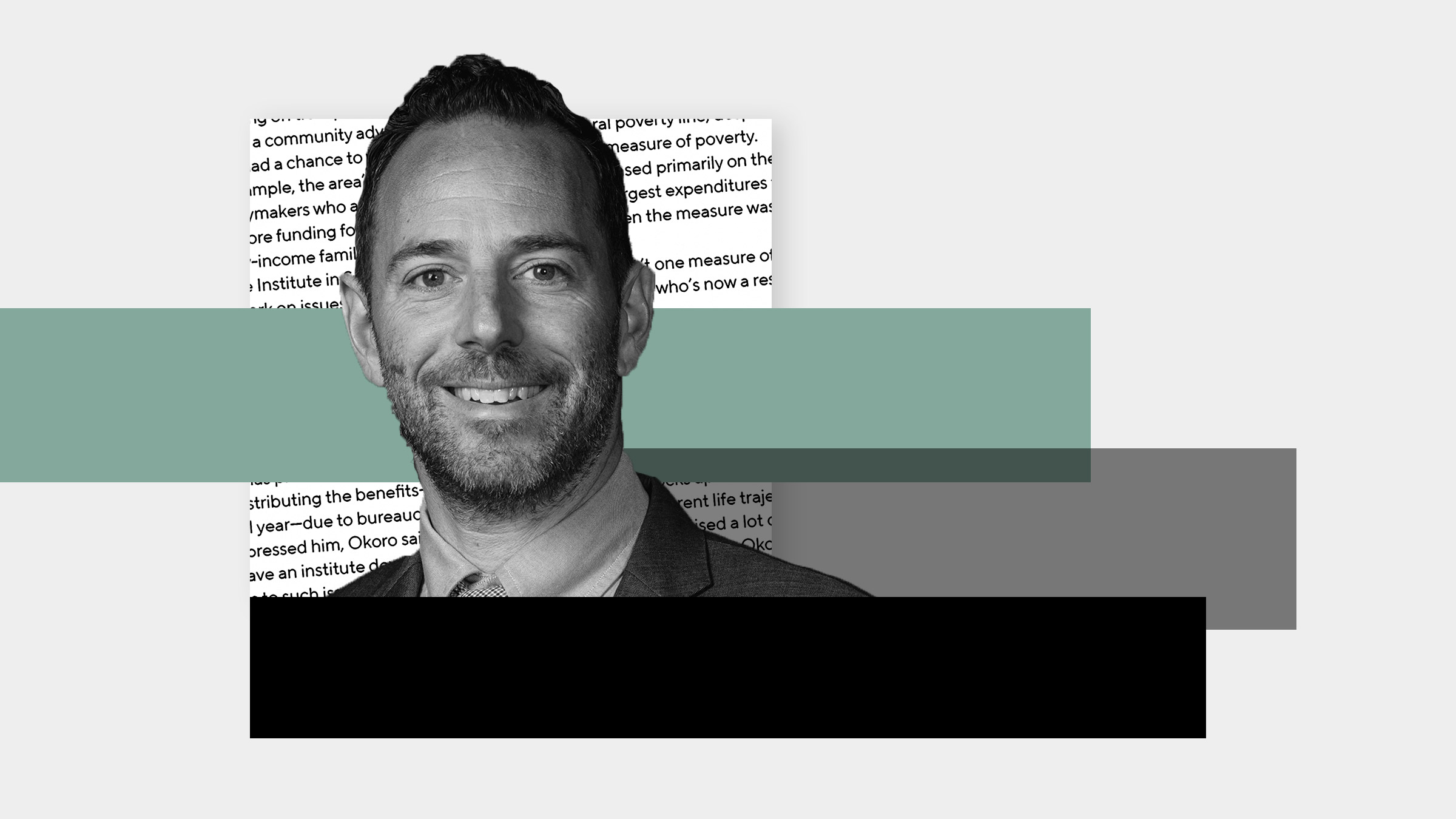
Economists can have peculiar ideas of “fun.” For Institute System affiliate Dan Hartley, it includes watching his causal identification strategy fall apart.
“When the data start telling us that things we think should be random don’t look like they’re random, there is a lot of fun in trying to think what could be going wrong,” Hartley said. He means it sincerely, taking joy in working with co-authors to develop an approach rigorous enough to survive expert journal reviewers. “Through data and mental gymnastics, we’re trying to beat up that assumption of randomness as much as we can.”
That sounds a bit like debugging code—an evolution from Hartley’s pre-econ background as an electrical and software engineer. His pivot to economics locked in during an MBA at the University of Chicago, with “the idea that I could study social issues and policy in a quantitative manner.”
First at the Cleveland Fed, Hartley launched a stream of work on the aftermath of natural disasters. From hurricanes to floods to tornadoes, he has studied how insurance and aid programs affect household finances. In a study spanning 614 recent disasters, Hartley and co-authors use an arbitrary debt-to-income cutoff to assess the benefits of a federal disaster loan program. “At this moment when families really need liquidity, it seems like these loans can be really helpful in staving off a debt spiral,” Hartley said.
Hartley joined the Chicago Fed in 2015, just as colleagues were digging into freshly digitized “residential security” maps from the 1930s. This launched his body of research on the effects—intended and unintended—of historic housing policies and practices. By looking for quasi-random variation, Hartley has documented how race-based redlining via residential security maps hurt children’s lifetime outcomes and still shapes the daily movement of people among neighborhoods. Another recent paper studies how a 1960s insurance policy reform ostensibly intended to boost low-income neighborhoods led instead to landlords neglecting and possibly even encouraging arson for profit.
Hartley is also investigating the long-term effects of “blockbusting,” in which midcentury realtors frightened White homeowners in targeted neighborhoods with the specter of integration, then scooped up those properties at a discount. They resold them at a steep markup—often with predatory financing—to Black families desperate for housing.
Despite being outlawed in 1968, the practice still marks our communities. Surveying the 60 largest cities, Hartley finds that neighborhoods targeted by blockbusting suffered depressed housing values in subsequent decades. One possible factor: much higher rates of foreclosure.This article is featured in the Spring 2026 issue of For All, the magazine of the Opportunity & Inclusive Growth Institute
More scholar spotlights from this issue
Kareem Haggag—Studying new frontiers in microfinance
Oksana Leukhina—A higher purpose for higher ed access
Jeff Horwich is the senior economics writer for the Minneapolis Fed. He has been an economic journalist with public radio, commissioned examiner for the Consumer Financial Protection Bureau, and director of policy and communications for the Minneapolis Public Housing Authority. He received his master’s degree in applied economics from the University of Minnesota.