Author
Danielle Cabot
Public Relations Associate
The research community at the Institute includes visiting scholars, consultants, economists, research analysts, and research assistants. These scholars bring varied backgrounds, interests, and expertise to research that deepens our understanding of economic opportunity and inclusion as well as policies that work to improve both.
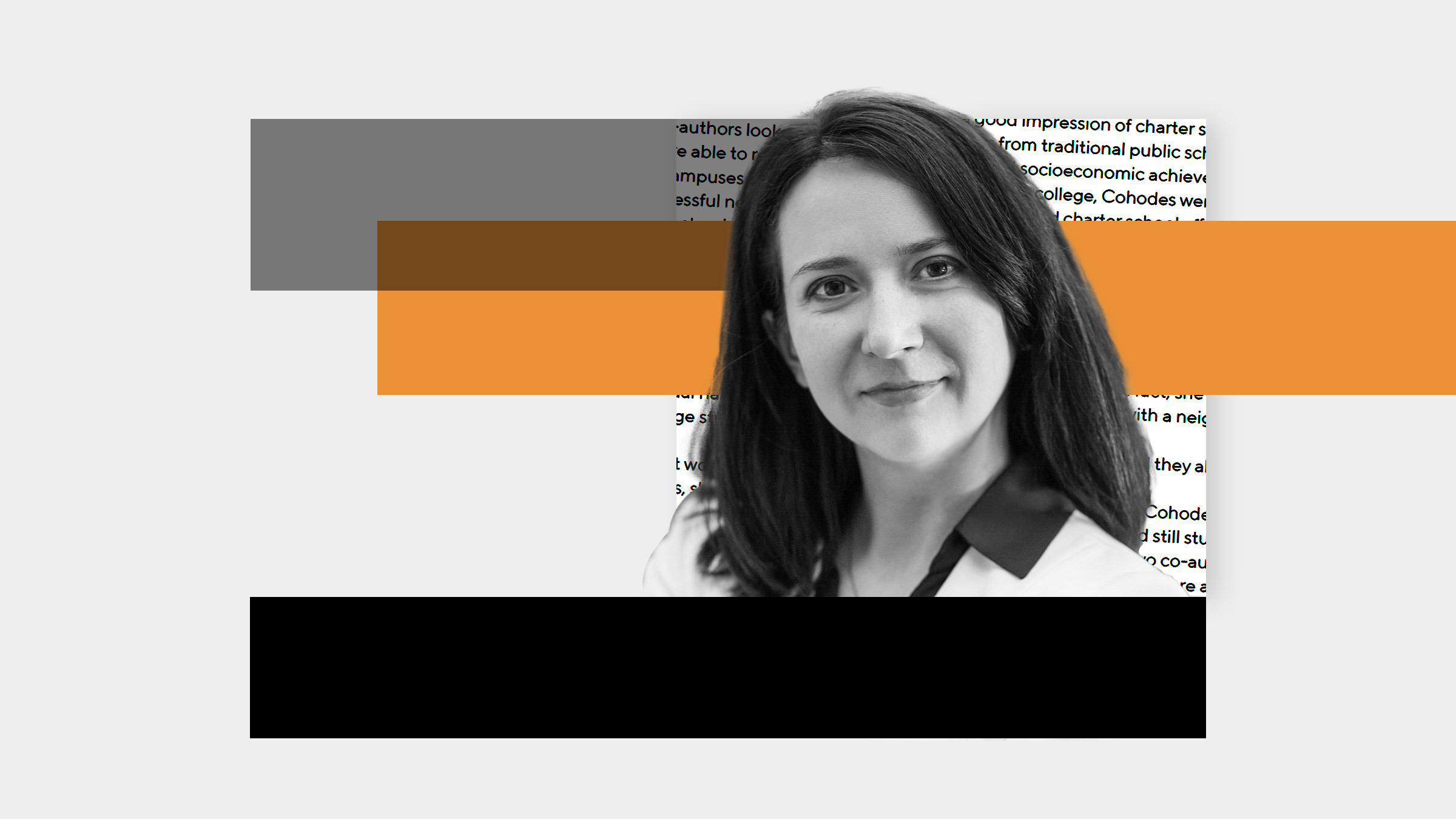
At first glance, Oksana Leukhina’s interests look a lot like political science: How do we design the right policies to ensure people have good lives? But beneath the surface is curiosity about where economic growth comes from.
Leukhina attributes this curiosity to her childhood in the former Soviet Union. “I had to actually live through all those economic shock therapies of the 1990s,” Leukhina said. “Basically, we had to transition from a planned economy to a free market economy—from a totalitarian regime to a democratic regime—and it wasn’t a smooth ride.”
After the Soviet Union dissolved, Leukhina came to the U.S. as part of an exchange program. While attending the College of Charleston, she discovered that economics wasn’t just about prices and inflation. It also offered her tools to study welfare and economic growth. With this sharpened focus, she made the leap to a Ph.D. program at the University of Minnesota.
Now Leukhina’s research agenda investigates access to high-quality post-secondary education and the role it plays in upward mobility.
A 2024 working paper examined the “quality undermatch” gap. The quality undermatch phenomenon refers to data showing that as many as 40 percent of students in the top quartile of aptitude testing don’t attend high-quality universities (think flagship state schools). The gap is even bigger for low-income students.
Leukhina’s ongoing research also measures how societal outcomes are affected if additional public investment expands capacity at these schools.
What Leukhina has found so far is that the cost is worth it. “It’s welfare-improving and pays for itself,” Leukhina said. “The kids are going to do better and generate the extra tax revenue needed to offset the initial investment.”
Another recent research strand explores lowering admissions criteria for lower-income students at high-quality colleges. Could this kind of intervention improve upward mobility for low-income students without causing a large loss in aggregate earnings? “I was shocked,” Leukhina said of the results. “It works really well in terms of improving upward mobility, and at almost no cost to aggregate earnings.”
While Leukhina’s analysis used a model simulation, several states are exploring related policies, adding relevance to her research and her work on the Institute’s System Affiliates Board.
“Policies related to ensuring that we have equality of opportunity have been at the center of my research. I feel like my vision is quite aligned with the Institute’s vision,” Leukhina said.