Authors


Ella Tracy
Intern, Institute
Article Highlights
- Modular approach holds promise for reducing construction time and costs
- Embedded perceptions of elevated risk challenge broader take-up
- Institutional change to accommodate modular construction is slow
Housing affordability is one of the most pressing issues Americans face today. Despite the evident need for additional housing, developers are struggling to build new units quickly and affordably without sacrificing quality. The housing industry is also facing rising costs for key inputs like land, labor, and lumber. To reduce expenses and increase productivity, some builders are exploring innovations such as volumetric modular construction, an emerging approach to factory-built housing.
For the Community Development and Engagement team at the Federal Reserve Bank of Minneapolis, understanding the current and potential impact of modular construction on housing affordability supports our mission to advance the economic well-being of low- to moderate-income individuals, households, and communities. As such, we set out to learn how modular construction can be leveraged to address cost, timeliness, and workforce challenges in multifamily housing production and to uncover the systemic and procedural barriers that are holding modular approaches back from broader adoption.
While Minnesota is home to over a thousand apartments built using modular construction, data about the costs and benefits are locked away in proprietary construction estimates and other project documents. In this absence of data, we turned instead to interviews with an array of housing-industry stakeholders in Minnesota, including modular housing builders, real estate developers, and inspectors. Their insights indicate that enthusiasm for the potential advantages of modular construction is tempered by hesitation over risks.
What volumetric modular is and isn’t
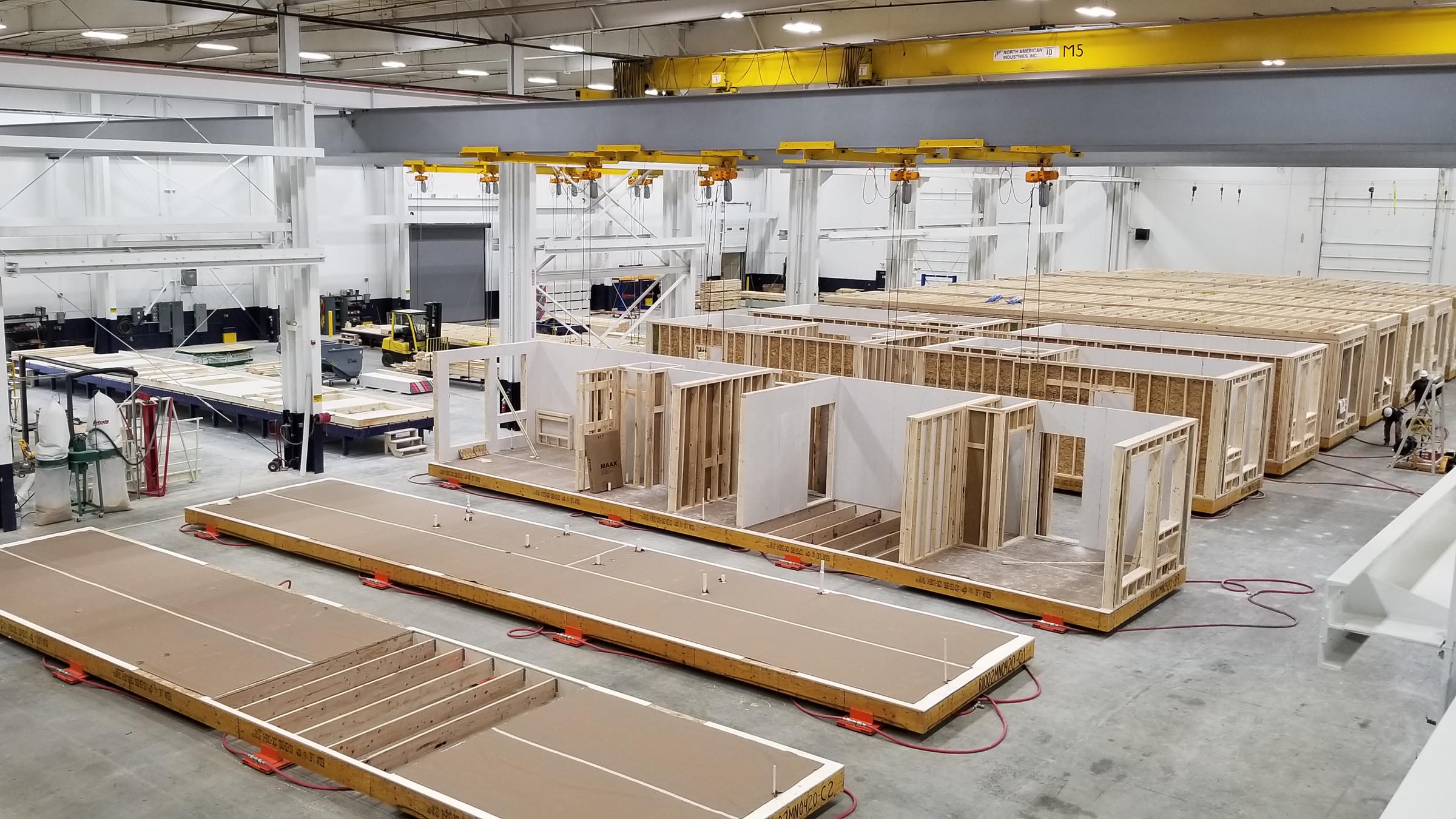
Volumetric modular is a construction process where sections of housing units are constructed at a factory, then shipped to a prepared project site and stacked together like interlocking toy blocks. The sections, typically called “mods,” are delivered with sheetrock, paint, bathrooms, windows, and cabinetry in place. Electrical, fire suppression, and plumbing systems are hooked together on-site. A customizable sheathing is affixed to the exterior of the building.
Modular housing is often confused with its factory-built brethren, manufactured housing and mobile homes. Modular housing, whether single-family or multifamily, complies with the same local and state building codes as traditional, on-site, “stick-built” construction. Manufactured housing, which consists of single-family homes built on steel chassis with wheels for initial portability, complies with the building standard that the U.S. Department of Housing and Urban Development (HUD) specified in its 1976 HUD Code. The term “mobile home” is used for portable units built before the implementation of the HUD Code’s requirements for higher-quality construction.
Several modular companies operate within Minnesota. Detroit Lakes-based Dynamic Homes has been delivering modular projects for over 50 years. Companies such as RISE Modular, AVA, and George Modular have emerged in the last decade.
Mods offer time savings, employment possibilities
Volumetric modular allows for concurrent site preparation and mod construction. If every step moves at optimum efficiency, interviewees told us that the schedule for modular projects could be 20 to 50 percent faster than comparable stick-built projects. When all goes according to plan, occupancy can begin within weeks of site preparation. Because time is money for developers, these time savings could drive an average of 5 to 10 percent total cost savings for projects using modular. That would be no small amount, especially when working with multimillion-dollar developments.
The modular model can help address today’s shortages of skilled workers in the construction industry. Modular construction occurs primarily in a permanent, temperature-controlled factory setting. This centralizes commuting to a single location and reduces the impact of bad weather. These factory jobs offer workers an opportunity to explore an array of construction trades. And using modular construction techniques requires less on-site labor than stick-built construction requires. For rural areas and other communities with small numbers of skilled tradespeople, this reduces the need to import labor.
Modular construction companies innovate to mitigate
Much of the hesitation surrounding modular construction comes from perceptions of risk. As with any innovation that disrupts the status quo, hiccups are somewhat unavoidable. AVA President Brian Nicholson said, “This is an infant industry in the U.S. just stubbing its toes a little bit.” Christian Lawrence, CEO of RISE Modular, noted that while the company has seen many successes, it has also “paid tuition and learned a number of lessons along the way.” Modular companies are already identifying or innovating solutions to mitigate the known problems.
For example, in nearly all our interviews with housing stakeholders, they vocalized concerns about water infiltration or other weather-related issues. However, the modular housing builders we interviewed said only a few projects have experienced major delays or increased expenses at the hands of unruly weather. According to Will Gorrilla of George Modular, “The [whole] industry is getting a black eye because [a handful of] people have had bad experiences with water damage.”
The modular housing builders expressed confidence in their ability to solve the waterproofing problems that have occurred. “Other countries have been building modular for decades,” said Nicholson of AVA. “We don’t need to look very far to find a solution.”
In another example, interviewees noted cost concerns about a critical component of the modular construction process: the transportation of the mods from the factory to their final site. Volumetric mods are typically shipped on semitrucks and classified as oversize loads. Most states require permitting and specialized escorts for oversize loads, incurring a cost that stick-built projects do not. However, Nicholson told us that AVA has found the costs of transportation to be minimal relative to the overall cost savings of modular.
If the traditional mods can’t fit down narrow or twisty streets to access some sites, modular is not a viable approach. An executive from George Modular said the company is developing steel-frame mods that will be smaller than their wood-frame counterparts, potentially allowing them greater access to small urban infill sites and reducing oversize-load permitting costs.

Another issue interviewees brought up was design. Some conveyed concern that the exteriors of modular buildings are boring and repetitive. One person expressed disappointment with a recently developed apartment building’s façade, which they said lacked exterior features and any interplay of light and shadow. However, developers using modular construction told us they’re already finding creative ways to embellish their buildings’ exteriors with colors, textures, and shapes. For example, Alvera Apartments, a seven-story modular building in St. Paul, is partly covered in an exterior mural. Modular construction imposes specific requirements on the interior design of multifamily buildings as well. Architects and designers have an initial learning curve as they learn how to work within modular construction’s constraints and specifications.
The modular housing industry also faces the challenge of negative perceptions about overall quality, perhaps resulting from the legacy of poor-quality construction of mobile homes prior to the 1976 adoption of the HUD Code. However, since each mod must be self-supporting and transportable by truck and crane, there are two complete walls side-by-side wherever two mods meet. As a result, modular construction uses about 30 percent more lumber than comparable stick-built projects. While this does shift costs, the double walls add durability and benefit residents with increased soundproofing.
Risk-averse institutions resist change
The current rules and systems for housing development, which evolved for stick-built housing, pose another set of challenges for modular construction. Local zoning requirements can complicate the modular benefit of duplication, for example. “Efficiencies come from making developments more repeatable, but differing municipal requirements make it hard to simply copy and paste projects across municipalities,” explained Joseph Peris of JLL Capital Markets, a commercial real estate firm whose work includes multifamily housing. Municipalities have varying requirements for things like lot setbacks, window coverage, and exterior materials that influence building shape and design. When the Minneapolis Public Housing Authority pursued construction of a series of modular buildings called the Family Housing Expansion Project (FHEP), it learned that even lots within the same city can place different constraints on the design of multiunit housing. The 16 sites in the FHEP required 11 design variations.
Local building inspectors have also experienced steep learning curves related to modular buildings. Under Minnesota Administrative Rules, the Minnesota Department of Labor and Industry inspects mods in the factories where they’re built. Local building inspectors sign off on the site foundation, the mod joining, and the connections among electrical, plumbing, and fire systems. Some local building officials we interviewed think this process makes their job easier. Others said they’d be more comfortable approving the finished product if they had personally overseen the construction process from beginning to end. One modular builder shared an anecdote about local inspectors requiring changes to a modular build at the project site after state inspectors had already approved the project in the factory. State and local building inspectors are still settling into the separate roles and responsibilities that factory-built housing requires.
On the financial side, modular construction requires a different timeline than traditional stick-built projects. In order to reserve factory space and procure materials, money may have to be spent before project financing closes. In the event that a project falls apart before closing, someone has to bear the cost. “The risk of spending money before closing the deal is unquantifiable,” said Chris Osmundson, director of Onward Investors in Minnesota. “The construction time might be shorter, but in order to break ground on day zero, you’ve been spending hard construction cost money for four months.”
Finding insurance, both builder’s risk insurance (to cover mod construction at the factory as well as building assembly at the project site) and property insurance (to cover the completed project after occupancy), can be a challenge for modular projects. Due to a perceived high risk of expensive repair costs, there are very few insurance groups willing to insure modular projects, which creates a near-monopoly on rates. One builder who does not use modular told us that their insurance rates would increase dramatically if they were to switch to full volumetric construction.
Some modular projects have struggled with a lack of clarity on which insurance policy is responsible for which stage of the construction process. Staff members from one city discussed a modular project in their municipality that was delayed by nearly a year after an unexpected severe storm damaged the temporary roof that had been placed over the mods on-site. In this case, the officials observed conflict between the project’s general contractor and insurer, who struggled to determine fiscal responsibility for repairs. In contrast, other interviewees told us about a different modular project that laid out a plan detailing what entity was financially responsible for each stage in the construction process, from storing supplies to manufacturing to transportation to setting up the mods.
We heard some optimism that more insurance companies may become willing to take on modular projects as the industry develops. With more options, pricing could become more competitive. And with more experience, the ecosystem is likely to develop more standard approaches for assigning risk.
The challenge of change
As Lawrence from RISE Modular said, “Modular can save time and money with the right team, processes, and coordination.” Volumetric modular construction is not appropriate for every housing development, and we certainly heard about multiple projects for which stick-built construction came in with lower cost estimates. However, modular’s potential benefits may make it worthwhile for developers to at least consider. With each successful modular project built, supporting institutions will have more information and experience to inform their assessments of modular’s risk.
Peris of JLL Capital Markets wants the housing industry to think about building homes like the auto industry thinks about building vehicles. “It’s not efficient to custom-build every car, but that’s how we currently produce housing,” he said. “At an F-150 factory, thousands of identical vehicles are produced, allowing for greater efficiencies and economies of scale.” Achieving this scale will require adaptation by developers, designers, investors, building inspectors, and insurance providers. If housing costs continue to outpace income growth, expanding the modular construction industry may become an essential strategy to build more housing more affordably.

Libby Starling is Senior Community Development Advisor in Community Development and Engagement at the Federal Reserve Bank of Minneapolis. She focuses on deepening the Bank’s understanding of housing affordability, concentrating on effective housing policies and practices that make a difference for low- and moderate-income families in the Ninth Federal Reserve District.