Author


War and geopolitics are naturally bound up with sovereign lending, borrowing, and other financial ties that connect nations. The Russian invasion of Ukraine has reinforced the need to integrate noneconomic conflict into economic models of sovereign debt, where it has not traditionally come into the picture. This includes the notion that geopolitical goals might run counter to economic self-interest.
The idea can be approached from each side of the lender-borrower relationship. What happens when a lender actually desires to pressure a borrower into default, as with the West and Russia? Minneapolis Fed Monetary Advisor Javier Bianchi modeled out this premise in a 2024 paper in the Journal of Monetary Economics.1
In a new working paper, Bianchi and co-authors take on the flip side, in which a borrower derives some benefit by defaulting on a loan from a geopolitical rival. (Minneapolis Fed Working Paper 816: “International Risk-Sharing in a Fragmented World” with Sebastian Horn, Giovanni Rosso, and César Sosa-Padilla.) How are sovereign debt contracts shaped by this possibility? If geopolitical factors lead borrowing to become more concentrated among friends, the economists foresee substantial implications for global financial stability.
The economists first empirically validate the premise that lending relationships fluctuate with geopolitics. Their index of “financial fragmentation” combines data on direct bilateral loans between countries with data from the international relations literature classifying country pairs as allies or nonallies from 1910 to 2023. Higher index values indicate sovereign lending overall is more concentrated among allied blocs; negative values are times when these relationships are more diversified.
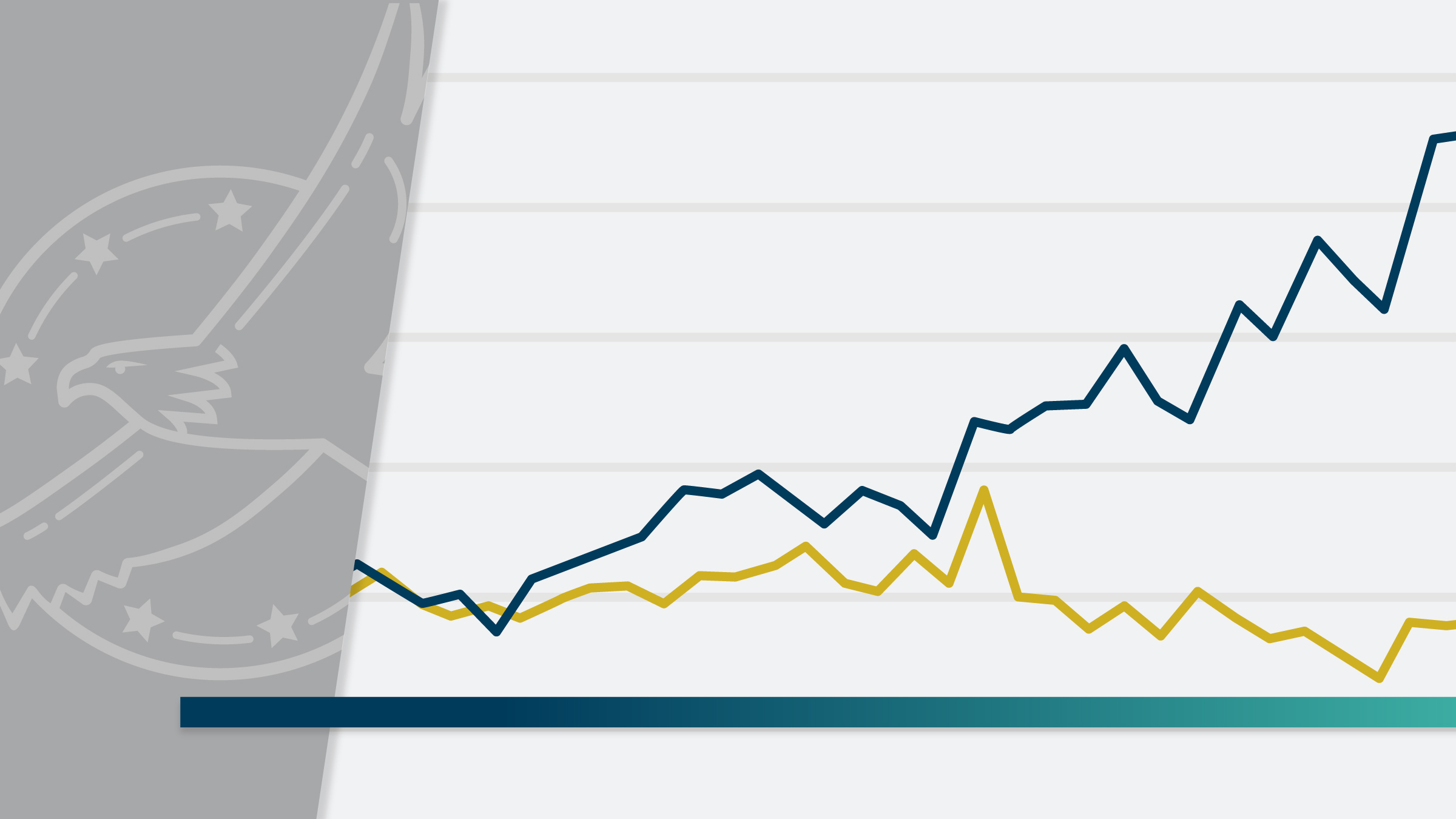
They plot their fragmentation index against a well-regarded index of geopolitical risk, illustrating a clear correspondence between years of higher global tension and the tendency of sovereign lending to concentrate among friendly blocs (see figure).2
Both indexes spike around the world wars and remain elevated through the Cold War. The fragmentation of sovereign borrowing fell to a historic low in 2020, before Russia’s invasion of Ukraine contributed to a reversal of the trend.
Bianchi and co-authors find that at the country level, a 10 percent increase in geopolitical risk is associated with a 1.5 percentage point increase in a country’s borrowing fragmentation during subsequent years (controlling for GDP, trade, and other financial indicators). A doubling of geopolitical risk would increase fragmentation by more than 10 percentage points. Flows of private credit and lending by multilateral institutions, such as the International Monetary Fund, appear much less sensitive to geopolitical conditions than bilateral lending.
What is the problem if countries concentrate their lending and borrowing among allies? Sovereign borrowing is a form of insurance, allowing the borrower to smooth consumption across good and bad economic times. The economists document that bilateral lending tends to reallocate resources from countries facing relatively low risk of major macroeconomic shocks to those with greater risk.
But these data also show that the economic cycles of allies tend to be much more synchronized than those of rivals. If borrower and lender face similar, contemporaneous risks, there is less scope for consumption-smoothing loans from the stronger economy to the weaker one. When changing geopolitical factors drive sovereign lending into friendly blocs, this reduces the potential for international risk-sharing.
To unpack the mechanics of bilateral lending amid geopolitical factors, Bianchi and co-authors build a two-period model of sovereign debt featuring a borrowing country and two blocs of international lenders, allied and rival. A “geopolitical externality” parameter captures the degree to which the borrower is hurt by the success of the rival bloc; one can imagine the value of this parameter rising in times of hostilities and falling in periods of relative peace.
To borrow enough to fully insure future consumption, the country in the model cannot rely solely on allies. But it also hurts its own welfare in making loan payments to the rival bloc (and derives some benefit from this channel if it defaults). The borrower is concerned with the composition of its creditors as well as the total amount of loans. Potential lending countries are also mindful of the borrower’s calculations as the sides negotiate an optimal arrangement of loans in the first period.
As the geopolitical externality grows, the total amount creditors are willing to lend shrinks as these lenders perceive the stronger incentive for the borrower to default down the road. Various scenarios arise depending on the cost of default to the borrower; in many cases, however, the borrower is unable to borrow enough internationally to fully smooth its consumption across future economic ups and downs.
The potential power of bilateral loans to spread risk across diverse economies is much diminished, as geopolitical fragmentation leads endogenously to financial fragmentation. In the model, as in the data, one form of global instability begets another.
Read the Minneapolis Fed working paper: “International Risk-Sharing in a Fragmented World”
Endnotes
1 See also our 2022 interview with Bianchi and co-author Sosa-Padilla in the context of the Russian debt default, hastened by sanctions by its international lenders.
2 The authors’ financial fragmentation index applies loan data from Horn et al., “States as Financiers: International Lending in War and Peace,” 2026, and alliance data from the Correlates of War project, extended through 2023 following Bailey et al., “Estimating Dynamic State Preferences from United Nations Voting Data,” 2017. Geopolitical risk index developed by Caldara and Iacoviello, “Measuring Geopolitical Risk,” 2022, and extended in Caldara et al., “Do Geopolitical Risks Raise or Lower Inflation?” 2026.

Jeff Horwich is the senior economics writer for the Minneapolis Fed. He has been an economic journalist with public radio, commissioned examiner for the Consumer Financial Protection Bureau, and director of policy and communications for the Minneapolis Public Housing Authority. He received his master’s degree in applied economics from the University of Minnesota.