Author


Article Highlights
- Monetary policy benefits from ever-improving understanding of how labor markets work
- Minneapolis Fed annually convenes specialists in microeconomic labor models and macroeconomists who study economy-wide trends
- Papers reassessed findings on American work hours, wage inequality, and market power wielded by employers
“Full employment” is one half of the Fed’s dual mandate. It is difficult to pursue this macroeconomic objective without understanding microeconomic dynamics: Large-scale patterns of growth and employment arise from the calculated decisions of firms, workers, and households. Yet the “macro people” and the “micro people” in economics don’t cross paths as often as one might think.
“We have specialized skills and we hang out with people in our narrow areas,” said Fernando Alvarez, a celebrated monetary and macroeconomist from the University of Chicago. Alvarez said the potential for “cross fertilization” drew him to Minneapolis for the second annual Micro and Macro Foundations of Labor Markets conference. “This is putting people together from different areas who typically don’t talk so much to one another,” said Alvarez, who is also a consultant to the Minneapolis Fed. “It’s very productive.”
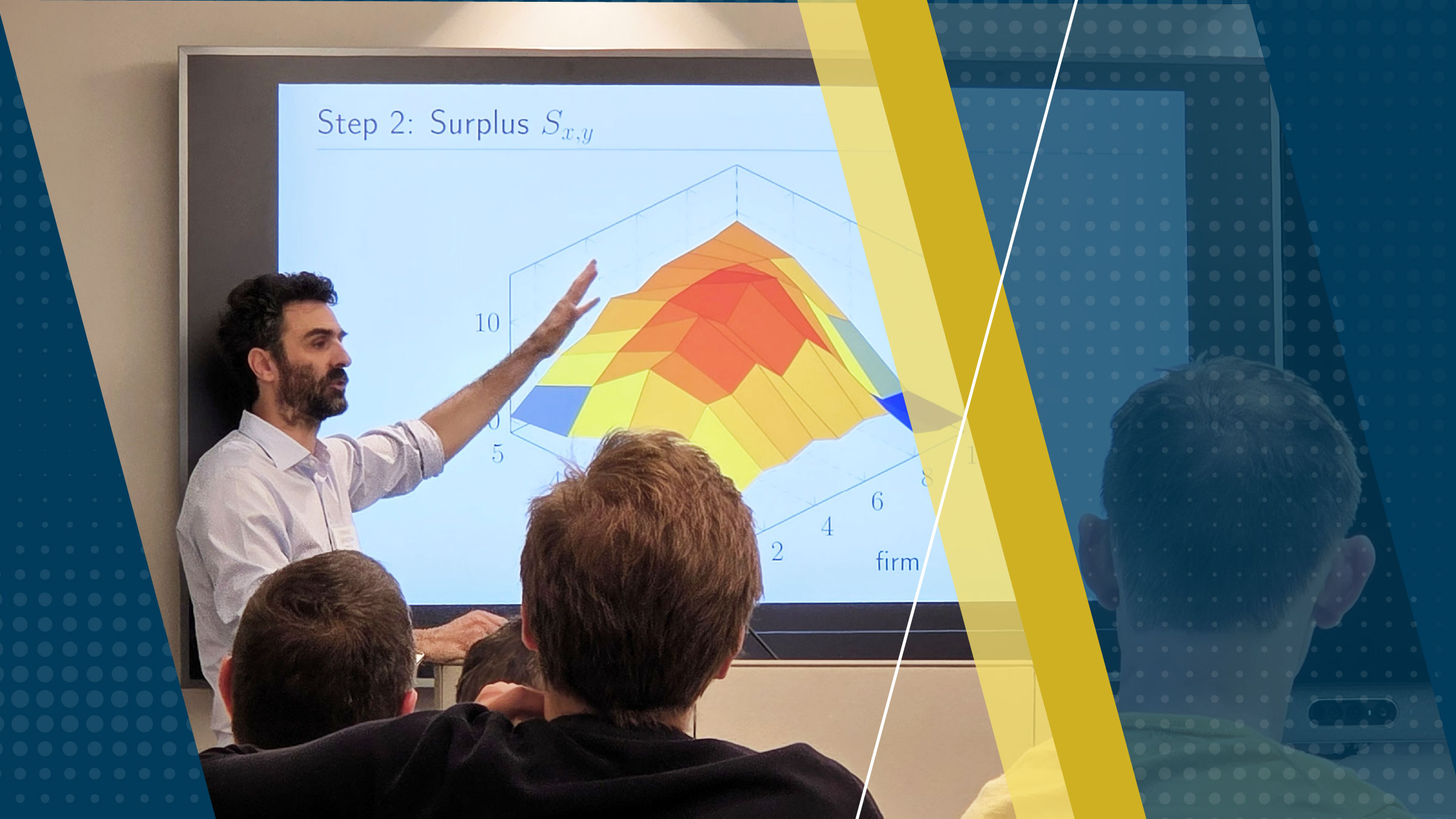
Alvarez joined top macro and labor economists at the Minneapolis Fed and University of Minnesota for the two-day conference in May. The agenda featured seven provocative presentations with a common thread: to advance economists’ mathematical models of how much workers work, how they match with employers, and how much firms pay them.
The conference “assembled almost all of the leading, serious quantitative labor economists in one room,” said University of Minnesota macroeconomist V. V. Chari, also a long-time Minneapolis Fed advisor. “All the papers are written by people who are doing first-class work. These are all leading lights in the labor field.”
The conference reinforced essential connections that inform the work of the Federal Reserve: connecting structural economic models and data; connecting microeconomic dynamics with macroeconomic outcomes; and connecting theoretical research to real-world policy.
“The Minneapolis Fed has always been the paragon for wanting to understand things deeply to give better policy advice,” said Princeton labor economist and Minneapolis Fed consultant Richard Rogerson, who presented new work challenging a prevailing theory about the hollowing out of the American middle class. In the Minneapolis Fed and University of Minnesota tradition, Rogerson said, the conference featured a heavy dose of economic theory and rigorous scrutiny. “That’s a long-run strategy for [generating] the knowledge that will help make better policy decisions.”
Revisiting major labor market findings
Rogerson’s paper addresses a documented “polarization” of the labor market since 1980: wage and employment growth at the top and bottom; stagnation and struggle for middle-income workers. Per one prominent explanation, this is the result of a shift in demand for certain skills and occupations, possibly because of changes in trade or technology.
Rogerson and co-authors find instead that these patterns in jobs and wages are much better explained by increasingly unequal rates of pay for people doing the same job. “We’re saying there is something big going on within occupations, when the standard narrative is there’s something big going on across occupations,” Rogerson said. “Those will call for very different policy responses.”
Research presented by the University of Minnesota’s Loukas Karabarbounis revisited another classic finding about the modern U.S. labor market. In 2004, former Minneapolis Fed economist Ed Prescott observed that from the 1970s to the 1990s, Americans steadily increased their working hours, ultimately working 50 percent more than Europeans. Karabarbounis, also a Minneapolis Fed consultant, examines why this trend subsequently reversed as America became one of the only advanced economies to experience a decline in hours worked.

“In the end, there is no smoking gun,” Karabarbounis told the room, but “a collection of evidence” pointing toward increasing health benefits for nonemployed U.S. workers. The number of Americans using Medicaid rose five times between the 1970s and 2020s. Alternative hypotheses, including demographic change, education, and incarceration rates, could not match the explanatory power of Medicaid in the economists’ model.
Importantly, the paper stops short of any welfare analysis, as pointed out by Mark Bils, the University of Rochester economist serving as the discussant on the paper. The comparison countries generally have some form of universal health insurance. “You could say Medicaid is just causing people not to work,” Bils said following the session. “But maybe that’s optimal. Maybe the way the Europeans do it isn’t so crazy.”
Bils epitomizes the goals of this event dedicated to linking microeconomic labor market data to macroeconomic policy, according to Erik Hurst of the University of Chicago, one of the conference organizers and an advisor to the Opportunity & Inclusive Growth Institute. Bils “is the godfather of this literature,” Hurst said. “He’s the O.G.—the first one who made it a career to do micro-macro.”
Hurst’s co-organizers were Patrick Kehoe and Simon Mongey of the Minneapolis Fed, Elena Pastorino of Stanford University, and Magne Mogstad of the University of Chicago.
Models, matching, and markdowns
Multiple papers offered rich models to better capture the complex process of employment: searching for jobs, matching with employers, negotiating wages, and maybe later parting ways.
Research from the University of Chicago’s Thibaut Lamadon seeks to quantify the core reasons why otherwise identical workers would receive different pay at different employers (“wage dispersion”). This includes the challenging task of modeling workers with varying preferences for nonwage amenities. Lamadon and co-authors find such “competitive differentials” account for half of observed wage dispersion. What might look, in other models, like market power by the employer might actually be workers trading wages off against other workplace qualities.
Lamadon describes himself as a labor economist with a macro background who doesn’t get to present often enough to macroeconomic specialists. “It’s great to come here to a broad audience,” Lamadon said. “I see huge value in that because it pushes you on the boundaries of the paper … and [to] see how you can make the arguments more convincing for them.”
A paper presented by Niklas Engbom of New York University brought a focus on economic development to the conference, with a model capturing the reorganization of developing economies around larger firms that rely heavily on white-collar workers. Engbom and co-authors, including Minneapolis Fed Principal Research Economist Todd Schoellman, also document the crucial connection between education levels and a nation’s share of white-collar employment.
Kehoe, a Minneapolis Fed monetary advisor, summarized the latest update on his work with Stanford’s Pastorino to forge a new generation of models that integrate labor market dynamics with the macroeconomic cycle of booms and recessions. By introducing a new micro-founded framework to the research of Robert Hall, Kehoe believes they are taking an important step toward synthesizing a “second generation” business cycle model.
Labor market models must make an important leap from static to dynamic, according to University of Pennsylvania economist Francesco Agostinelli. Agostinelli and co-authors propose a model in which firms and potential hires contemplate their long-term relationship—not just the first-year wage, but a sequence of wages and skill-building in coming years.
When negotiating compensation, “now the incentive for the firm is both hiring workers as well as retaining them,” Agostinelli told the conference. “I want to prevent workers from leaving, so how do I make them happy? I can pay them more today or I can give them a promise of future happiness.” New hires also weigh a starting salary against the opportunity to build human capital over time.
The economists argue in their paper that their “dynamic wage setting” model “fundamentally changes the way we think about how firms exercise wage-setting power.” Many labor market models feature a presumption of monopsony: Firms have some market power to “mark down” wages—that is, to pay less than a worker’s marginal product. But Agostinelli and co-authors find these markdowns tend to look smaller in a model where both parties are negotiating a long-term relationship.
A different vision for the discussant
Findings presented by Benjamin Schoefer of the University of California, Berkeley, also question the scale of monopsony power. Monopsony has become “the go-to framework that has been replacing the canonical competitive model” of labor markets, Schoefer said. “It’s probably the most parsimonious and powerful theory to think through a lot of labor market phenomena.”
These phenomena include minimum wage policies, which can be economically efficient to the extent that they undermine the monopsony market power of employers. Studying changes around a minimum wage change in Germany in 2015, however, Schoefer and co-authors find “strikingly limited evidence” that monopsony is a major factor in the wage markdowns of workers.
The volley of questions that met Schoefer’s paper showcased the conference’s novel approach to the role of “discussant.” As usual, the assigned discussant arrived having given a close reading of the paper. But rather than delivering a formal slide deck and response to the paper, as in the well-worn tradition of economic conferences, the discussant was tasked as a facilitator for the conversation in the room.
“In some ways your goal is to be kind of an assistant to the presenter and help them along,” said Harvard economist Oscar Volpe, the discussant for the lively debate on Schoefer’s paper. “I thought it was a lot of fun, honestly, and it was my first time doing it” that way. “I think the right kinds of questions were being brought up, criticisms of the paper, but at the same time we needed to move along,” Volpe said.
The tough-but-constructive audience in Minneapolis will make all of the presented research stronger, Schoefer said. “What’s great is the rigor, the high-intensity attention, the connection between theory and data, bringing together micro- and macroeconomists on these important labor market questions,” Schoefer said. “It’s a special conference, I would say.”
Conference Papers
Agostinelli, Francesco, Domenico Ferraro, Giuseppe Sorrenti, and Leonard Treuren. “Employment Relationships, Wage Setting, and Labor Market Power.” NBER Working Paper 34439 (2025). https://doi.org/10.3386/w34439.
Birinci, Serdar, Loukas Karabarbounis, and Kurt See. “Why Do Americans No Longer Work So Much More Than Non-Americans?” Minneapolis Fed Working Paper 813 (2026). https://doi.org/10.21034/wp.813.
Engbom, Niklas, Hannes Malmberg, Tommaso Porzio, Federico Rossi, and Todd Schoellman. “Economic Development According to Chandler.” NBER Working Paper 34483 (2025). https://doi.org/10.3386/w34483.
Erosa, Andrés, Luisa Fuster, Gueorgui Kambourov, and Richard Rogerson. “Labor Market Polarization and Inequality: A Roy Model Perspective.” NBER Working Paper 33687 (2025). https://doi.org/10.3386/w33687.
Faia, Ester, Benjamin Lochner, and Benjamin Schoefer. “Monopsony, Markdowns, and Minimum Wages.” NBER Working Paper 34699 (2026). https://doi.org/10.3386/w34699.
Lamadon, Thibaut, Jeremy Lise, Costas Meghir, and Jean-Marc Robin. “Labor Market Matching, Wages, and Amenities.” NBER Working Paper 32687 (2024). https://doi.org/10.3386/w32687.

Jeff Horwich is the senior economics writer for the Minneapolis Fed. He has been an economic journalist with public radio, commissioned examiner for the Consumer Financial Protection Bureau, and director of policy and communications for the Minneapolis Public Housing Authority. He received his master’s degree in applied economics from the University of Minnesota.